Artificial Intelligence and Virology: Separating Promise from Hype
|
Elizabeth M. Traverse, Global Virus Network
Al Ozonoff, Broad Institute School, Managing Director of Sentinel, and Global Virus Network
Marco Salemi, University of Florida, Emerging Pathogens Institute and Global Virus Network
Sten H. Vermund, University of South Florida, College of Public Health and Global Virus Network
|
| Abstract |
|
AI is everywhere, and virology, awash in genomic, laboratory, and surveillance data, is often named as a field ripe for transformation. But what can AI realistically do for virologists? In this commentary, we argue that AI will not replace scientific expertise. Its real value lies in accelerating selected analytic tasks while exposing persistent weaknesses in our data systems and surveillance. We look at where AI has already earned its place (genomic analysis, variant forecasting, protein structure prediction) and where enthusiasm has outpaced the evidence. One theme recurs throughout: AI is only as good as the data behind it.
The future of virology will not be humans versus AI, but how well the two work together.
|
|
Why AI and Virology Are Converging Now
|
|
Artificial intelligence (AI) is everywhere. Computers and phones are inundated with AI suggestions and helpers, companies use AI for everything from customer service to data analysis, and educational institutions are actively debating how to incorporate these tools into learning. In science, AI is already accelerating large-scale genomic analysis, to give one example, but its impact remains uneven and highly dependent on data quality. An important question for virologists is, “what role can artificial intelligence realistically play in understanding, detecting, and responding to viral threats?”
The field of virology is potentially well positioned to explore AI applications as modern viral research generates enormous amounts of data (1). Viral genomes, laboratory results, epidemiological trends, environmental monitoring data, and clinical information are all increasingly collected at unprecedented scales. Turning these massive datasets into meaningful insights requires tools that can identify patterns quickly and efficiently. The COVID-19 pandemic demonstrated both the importance and the challenges of this rapid data analysis, real-time information sharing, predictive modeling, and global genomic surveillance, as researchers coordinated efforts to characterize the virus and inform public health decisions (2). At the same time, the pandemic also highlighted limitations. Incomplete or disconnected surveillance systems, unequal access to resources, fragmented data sharing, and the difficulty of predicting how viruses will evolve were all significant challenges (2).
The speed and efficiency of AI may help address some of these gaps in certain scientific workflows. However, it is important to recognize that AI is not a replacement for virologists, experimental biologists, epidemiologists, or public health experts (3). We do not believe that AI will transform virology by replacing expertise; its real value lies in accelerating selected analytic tasks while exposing persistent weaknesses in data systems, surveillance, and integration. Scientific discovery depends on creativity, contextual understanding, and careful interpretation, qualities that cannot be replicated by an algorithm. Instead, AI is best viewed as a tool that can augment human expertise when applied thoughtfully, ethically, and with appropriate validation.
What AI will mean for working virologists is one of the major questions that will have to be addressed in the future. AI is already useful in helping articulate sequence analysis pathways, for example, and using genomic information to predict SARS-CoV-2 successful lineages (4). In contrast, AI must be used with caution for outbreak prediction claims, until we have better field diagnostics, wider availability, and data that can suggest infection fatality rates rather than case fatality rates, a critical distinction as noted with COVID-19 (5,6). Building our skills in data literacy and validation, and our interdisciplinary collaborations will be essential.
|
|
Why is There So Much Hype Around AI Right Now?
|
|
Artificial intelligence algorithms have been developed since the early 1970s. Yet, recent advances in computing power, data availability, and generative AI tools have brought it into the public spotlight. The rapid growth of tools that can generate text, images, and analyses has created excitement across nearly every industry. In virology, interest in AI has grown alongside increasing recognition that traditional approaches alone may struggle to keep pace with the volume and complexity of modern biological data (3). Viral evolution occurs continuously, sequencing technologies generate millions of genetic records, and public health systems must integrate information from laboratories, hospitals, animals, and the environment. AI appears well suited to help address these challenges, as it can analyze large datasets and identify patterns faster than traditional approaches.
AI enthusiasm, however, can sometimes move quicker than the evidence. AI can recognize patterns rapidly; it cannot yet explain causality at its stage of development, although causal AI methods are being actively developed (7). Many AI tools are still in early research stages, and their performance in controlled studies does not always translate directly into real-world public health settings. A model that performs well using a carefully curated dataset may struggle when faced with incomplete surveillance data, inconsistent reporting, or changing biological conditions (8). One of the most common areas of overstatement involves predicting future outbreaks. While AI models may help identify trends, estimate risk, or highlight unusual patterns, predicting when and where a novel virus will emerge remains an extremely difficult scientific challenge (9). Viral emergence depends on complex interactions between biology, ecology, animal populations, human behavior, and social factors, many of which are difficult to capture computationally. AI works well on curated datasets; it struggles in fragmented surveillance systems. Like many technologies before it, AI may prove most valuable when integrated carefully into existing systems, improving certain points in the process rather than being treated as a standalone solution. AI will not substitute for biological judgment in the next decades; its output must be interpreted within evolutionary, immunologic, and epidemiologic context.
|
|
Where Has AI Already Shown Value in Virology?
|
|
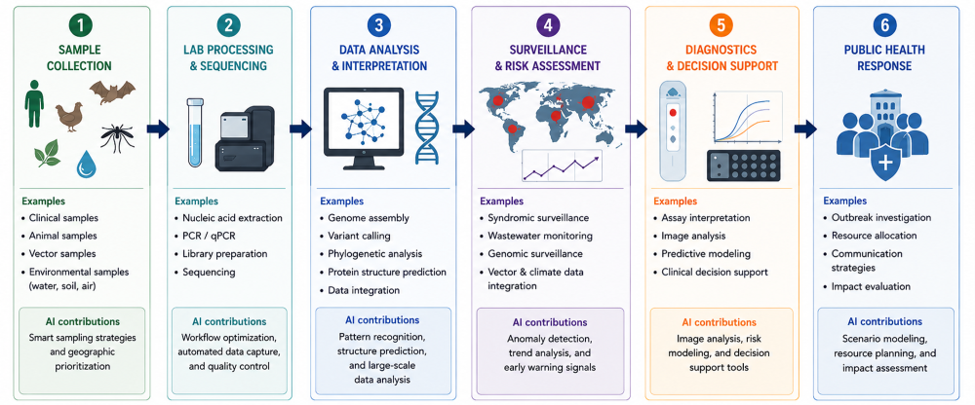
Although some AI applications remain experimental, several areas have already shown meaningful potential in virology. One of the strongest applications is viral genomic analysis (10). Modern sequencing technologies allow scientists to rapidly generate viral genome data, but interpreting those datasets requires extensive computational processing. AI-assisted approaches can help identify genetic similarities, detect mutations, organize viral sequences, and support analyses. During the COVID-19 pandemic, genomic surveillance was essential for tracking SARS-CoV-2 variants, monitoring evolution, and understanding transmission patterns (2). Assessing rapid variant clustering with AI was gratifying and empowering, as AI did succeed in helping forecast variant dominance (4,11,12).
AI has also contributed to structural biology and research workflows. Tools that assist with predicting viral protein structures can help researchers better understand viral components involved in infection, immunity, diagnostics, and treatment development (13,14). AI’s potential is also being investigated in diagnostics, drug discovery, and vaccine research (15,16). It may help analyze laboratory data, prioritize antiviral candidates, and identify potential vaccine targets. However, computational predictions still require laboratory validation, safety testing, and clinical evaluation. Many promising predictions fail when tested in biological systems, which remain highly complex (16).
Further, AI is being explored as a tool for infectious disease surveillance. Detecting viral threats early requires integrating information from many sources, including clinical laboratories, wastewater monitoring, wildlife surveillance, and environmental data. This aligns closely with the One Health approach, which recognizes that human health is connected to the health of global life. AI-assisted systems may help identify unusual disease patterns, analyze viral sequences, monitor vector-borne disease risks, and integrate diverse datasets (17). However, AI-driven surveillance depends heavily on the quality of available data. Gaps in sequencing capacity, animal monitoring, environmental sampling, and data sharing can limit what AI systems can detect. Ultimately, AI’s greatest value in virology may come from strengthening, but not replacing, scientific expertise. The future of AI in virology will depend on combining advanced computational tools with rigorous laboratory research, high-quality data, and expert interpretation (Figure 1).
|
|
|
Figure 1: Potential applications of AI in regular virology workflows.
|
|
The Data Problem: AI Is Only as Good as the Information Behind It
|
|
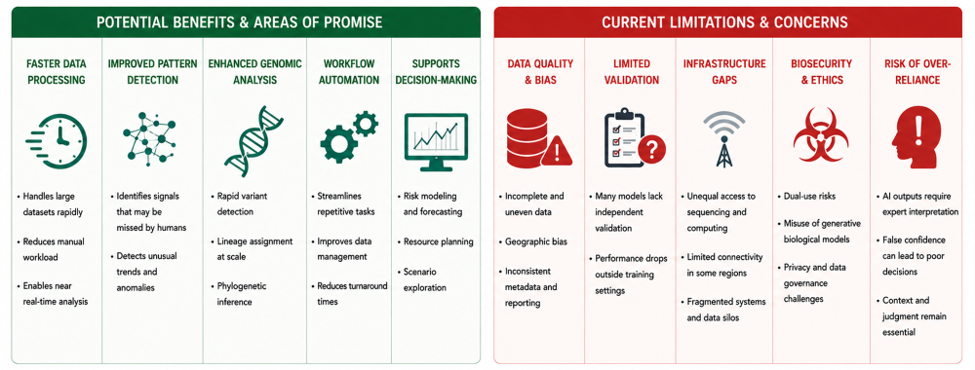
The main limitation to AI in virology is not algorithmic performance; rather, it is the uneven, incomplete, and non-representative nature of global viral data. AI models learn from existing information. If that information is incomplete, biased, or inconsistent, the resulting predictions may also be limited (18). Global genomic databases do not always represent all regions equally. Some countries have extensive sequencing capacity, while others may contribute fewer viral sequences because of limited resources (19). Similarly, animal and environmental surveillance programs are often less developed than human health surveillance systems, the “One Health” gap. For example, global influenza surveillance depends on national laboratories submitting representative viral isolates from humans and nature (20). Regions with limited surveillance contribute fewer viral genomes, reducing the ability of computational models to accurately characterize viral evolution and inform vaccine strain selection (21). Gaps such as these can influence AI performance, a model trained primarily on data from well-resourced regions may not accurately reflect viral patterns in areas where less data is available (Figure 2).
Data quality issues are also widespread. These include inconsistent sample collection methods, missing information about sample origins, differences in laboratory protocols, and incomplete reporting (19). These challenges are not unique to AI and are longstanding issues in global health surveillance. In wastewater surveillance, an important tool for monitoring SARS-CoV-2, poliovirus, influenza, and other pathogens, differences in sampling frequency, concentration methods, nucleic acid extraction protocols, and reporting standards make it difficult for AI models to distinguish methodological variation from genuine epidemiologic trends (22). Additionally, AI can obscure these limitations when highly complex models produce results that appear authoritative even when underlying data are incomplete or of poor quality, thus risking “false precision”. (23). Strong AI applications therefore require strong scientific foundations: reliable data collection, standardized methods, transparent models, and expert review.
Finally, AI cannot identify what has never been observed or sequenced, yet most viral diversity remains uncharacterized. Environmental metagenomic studies continue to discover entirely new viral families, meaning AI systems often have limited ability to recognize or classify viruses that fall outside existing reference databases (10). Continued investment in field surveillance, laboratory discovery, and basic virology research is therefore essential, as these efforts generate the knowledge upon which AI models depend. |
|
|
Figure 2: Benefits and limitations to AI usage in virology.
|
|
Biosecurity, Ethics, and Governance Concerns
|
|
As AI becomes more integrated into biological research, questions about responsible use are becoming increasingly important. Concerns include how sensitive genomic information is shared, how models are governed, and how access to powerful biological tools is managed. One area of discussion is dual-use research: the possibility that scientific advances intended for beneficial purposes could also be misused (24). As AI systems become more capable of analyzing biological information, researchers and policymakers must consider how to encourage innovation while maintaining appropriate safeguards (Figure 2). Other concerns include privacy of genetic and health data, transparency of AI decision-making, unequal access to advanced technologies, and overreliance on automated recommendations (25). Responsible AI development requires collaboration between scientists, public health professionals, policymakers, ethicists, and communities (26).
Human expertise remains central to virology. AI systems can identify patterns, process information, and assist with analysis, but they do not replace the experience of scientists who understand biological systems (3). Virologists interpret results within the context of evolution, transmission, immunity, and disease mechanisms. Laboratory scientists understand how samples are collected, processed, and validated. Public health experts evaluate how scientific findings translate into real-world decisions. The question is not whether AI will replace virologists. Instead, the more important question is how virologists can use AI responsibly to strengthen their work (Figure 2).
|
|
Looking Ahead: What Realistic Progress May Look Like
|
|
AI has the potential to become a key tool in virology research, but its long-term impact will depend on careful implementation (1). The future of virology will be shaped less by AI itself than by our willingness to invest in the data systems, collaborations, and scientific judgment that make those tools useful. Future progress may come from improved genomic surveillance, integrated human-animal-environmental datasets, standardized metadata frameworks, more efficient research workflows, and stronger collaboration between computational and laboratory scientists. Multidisciplinary teams will enable validation of AI tools in real-world outbreak settings. Legal and ethical expertise will help virologists establish governance structures for dual-use AI risks (e.g., beneficial purposes for vaccines and surveillance vs. misuse to enhance pathogens as bioweapons). The future of virology will not be defined by humans versus AI, but by how effectively humans and AI can work together. When used thoughtfully, AI may help scientists detect threats faster, analyze complex information more effectively, and strengthen global preparedness for the viral challenges ahead (27). In summary, whether AI will become a durable asset in virology will depend less on technological novelty and more on careful data assembly and validation (28), equitable implementation, transparent governance, and continued investment in both computational and laboratory science.
|
| References |
- Padhi A, Agarwal A, Saxena SK, Katoch CDS. Transforming clinical virology with AI, machine learning and deep learning: a comprehensive review and outlook. VirusDisease. 2023 Sep;34(3):345–55. doi:10.1007/s13337-023-00841-y PubMed PMID: 37780897; PubMed Central PMCID: PMC10533451.
- Tosta S, Moreno K, Schuab G, Fonseca V, Segovia FMC, Kashima S, et al. Global SARS-CoV-2 genomic surveillance: What we have learned (so far). Infect Genet Evol. 2023 Mar;108:105405. doi:10.1016/j.meegid.2023.105405 PubMed PMID: 36681102; PubMed Central PMCID: PMC9847326.
- Kuchipudi SV, Norris DE, Pekosz A, Pipas JM. The nexus of artificial intelligence and virology: transformative but with potential perils. BMJ Glob Health. 2025 Nov 21;10(11):e021140. doi:10.1136/bmjgh-2025-021140 PubMed PMID: 41285433; PubMed Central PMCID: PMC12645659.
- Rancati S, Nicora G, Prosperi M, Bellazzi R, Salemi M, Marini S. Forecasting dominance of SARS-CoV-2 lineages by anomaly detection using deep AutoEncoders. bioRxiv: The Preprint Server for Biology; 2024. doi:10.1101/2023.10.24.563721 PubMed PMID: 37961168; PubMed Central PMCID: PMC10634784.
- Vermund SH, Pitzer VE. Asymptomatic Transmission and the Infection Fatality Risk for COVID-19: Implications for School Reopening. Clin Infect Dis Off Publ Infect Dis Soc Am. 2021 May 4;72(9):1493–6. doi:10.1093/cid/ciaa855 PubMed PMID: 32584967; PubMed Central PMCID: PMC7337644.
- Meyerowitz-Katz G, Merone L. A systematic review and meta-analysis of published research data on COVID-19 infection fatality rates. Int J Infect Dis IJID Off Publ Int Soc Infect Dis. 2020 Dec;101:138–48. doi:10.1016/j.ijid.2020.09.1464 PubMed PMID: 33007452; PubMed Central PMCID: PMC7524446.
- Bhasuran B, Prosperi M, Hanna K, Petrilli J, Washington CJ, He Z. Evaluation of causal reasoning for large language models in contextualized clinical scenarios of laboratory test interpretation. NPJ Digit Med. 2026 Apr 23. doi:10.1038/s41746-026-02632-3 PubMed PMID: 42020503.
- El Arab RA, Abu-Mahfouz MS, Abuadas FH, Alzghoul H, Almari M, Ghannam A, et al. Bridging the Gap: From AI Success in Clinical Trials to Real-World Healthcare Implementation—A Narrative Review. Healthcare. 2025 Mar 22;13(7):701. doi:10.3390/healthcare13070701 PubMed PMID: 40217999; PubMed Central PMCID: PMC11988730.
- Kaur J, Butt ZA. AI-driven epidemic intelligence: the future of outbreak detection and response. Front Artif Intell. 2025 Jul 30;8:1645467. doi:10.3389/frai.2025.1645467 PubMed PMID: 40810005; PubMed Central PMCID: PMC12343573.
- Chisompola D, Luwaya E, Nzobokela J, Mwansa P, Chakulya M. AI-powered analysis of viral metagenomic sequencing data for rapid outbreak investigation and novel pathogen discovery. Front Microbiol. 16:1717859. doi:10.3389/fmicb.2025.1717859 PubMed PMID: 41602756; PubMed Central PMCID: PMC12833367.
- Nicora G, Salemi M, Marini S, Bellazzi R. Predicting emerging SARS-CoV-2 variants of concern through a One Class dynamic anomaly detection algorithm. BMJ Health Care Inform. 2022 Dec;29(1):e100643. doi:10.1136/bmjhci-2022-100643 PubMed PMID: 36593658; PubMed Central PMCID: PMC9742845.
- NICORA G, MARINI S, SALEMI M, BELLAZZI R. Dynamic Prediction of Non-Neutral SARS-Cov-2 Variants Using Incremental Machine Learning. Stud Health Technol Inform. 2022 May 25;294:654–8. doi:10.3233/SHTI220550 PubMed PMID: 35612170; PubMed Central PMCID: PMC11093215.
- Helmy M, Shafei F, Pellegrina D, Jin L, Alhossary A, Wilson HL, et al. AI-driven discovery in protein science for immunology and infectious disease research. Front Bioinforma. 6:1760257. doi:10.3389/fbinf.2026.1760257 PubMed PMID: 42051590; PubMed Central PMCID: PMC13111274.
- Metsky HC, Welch NL, Pillai PP, Haradhvala NJ, Rumker L, Mantena S, et al. Designing sensitive viral diagnostics with machine learning. Nat Biotechnol. 2022 Jul;40(7):1123–31. doi:10.1038/s41587-022-01213-5
- Fahim YA, Hasani IW, Kabba S, Ragab WM. Artificial intelligence in healthcare and medicine: clinical applications, therapeutic advances, and future perspectives. Eur J Med Res. 2025 Sep 23;30:848. doi:10.1186/s40001-025-03196-w PubMed PMID: 40988064; PubMed Central PMCID: PMC12455834.
- Blanco-González A, Cabezón A, Seco-González A, Conde-Torres D, Antelo-Riveiro P, Piñeiro Á, et al. The Role of AI in Drug Discovery: Challenges, Opportunities, and Strategies. Pharmaceuticals. 2023 Jun 18;16(6):891. doi:10.3390/ph16060891 PubMed PMID: 37375838; PubMed Central PMCID: PMC10302890.
- Villanueva-Miranda I, Xiao G, Xie Y. Artificial intelligence in early warning systems for infectious disease surveillance: a systematic review. Front Public Health. 2025 Jun 23;13:1609615. doi:10.3389/fpubh.2025.1609615 PubMed PMID: 40626156; PubMed Central PMCID: PMC12230060.
- Cross JL, Choma MA, Onofrey JA. Bias in medical AI: Implications for clinical decision-making. PLOS Digit Health. 2024 Nov 7;3(11):e0000651. doi:10.1371/journal.pdig.0000651 PubMed PMID: 39509461; PubMed Central PMCID: PMC11542778.
- Fatumo S, Chikowore T, Choudhury A, Ayub M, Martin AR, Kuchenbäcker K. Diversity in Genomic Studies: A Roadmap to Address the Imbalance. Nat Med. 2022 Feb 1;28(2):243–50. doi:10.1038/s41591-021-01672-4 PubMed PMID: 35145307; PubMed Central PMCID: PMC7614889.
- Lou J, Liang W, Cao L, Hu I, Zhao S, Chen Z, et al. Predictive evolutionary modelling for influenza virus by site-based dynamics of mutations. Nat Commun. 2024 Mar 21;15(1):2546. doi:10.1038/s41467-024-46918-0
- Huddleston J, Bedford T. Timely vaccine strain selection and genomic surveillance improve evolutionary forecast accuracy of seasonal influenza A/H3N2. eLife. 14:RP104282. doi:10.7554/eLife.104282 PubMed PMID: 41343299; PubMed Central PMCID: PMC12677901.
- van der Drift AMR, Welling A, Arntzen V, Nagelkerke E, van der Beek RFHJ, de Roda Husman AM. Wastewater surveillance studies on pathogens and their use in public health decision-making: a scoping review. Sci Total Environ. 2025 Sep 1;993:179982. doi:10.1016/j.scitotenv.2025.179982
- Özer M. Is Artifical Intelligence Hallucinating? Turk J Psychiatry. 2024 Oct 14;35(4):333–5. doi:10.5080/u27587 PubMed PMID: 39398861; PubMed Central PMCID: PMC11681264.
- Flores-Coronado JA, Alanis-Valdez AY, Herrera-Saldivar MF, Flores-Flores AS, Vazquez-Guillen JM, Tamez-Guerra RS, et al. Awareness of the dual-use dilemma in scientific research: reflections and challenges to Latin America. Front Bioeng Biotechnol. 2025 Jul 28;13:1649781. doi:10.3389/fbioe.2025.1649781 PubMed PMID: 40791856; PubMed Central PMCID: PMC12336261.
- Pham T. Ethical and legal considerations in healthcare AI: innovation and policy for safe and fair use. R Soc Open Sci. 12(5):241873. doi:10.1098/rsos.241873 PubMed PMID: 40370601; PubMed Central PMCID: PMC12076083.
- Siddiqui SM, Arizti-Sanz J, Rao AS, Ozonoff A, Sabeti PC. Ensuring Biosecurity and Research Agility for Outbreak Response: A Researcher’s Perspective on the Federal Nucleic Acid Screening Framework. Appl Biosaf J Am Biol Saf Assoc. 2025 Aug;30(3):211–6. doi:10.1089/apb.2024.0063 PubMed PMID: 40927142; PubMed Central PMCID: PMC12415158.
- McKee M, Rosenbacke R, Stuckler D. The power of artificial intelligence for managing pandemics: A primer for public health professionals. Int J Health Plann Manage. 2025 Jan;40(1):257–70. doi:10.1002/hpm.3864 PubMed PMID: 39462894; PubMed Central PMCID: PMC11704850.
- Rancati S, Nicora G, Bergomi L, Buonocore TM, Czyz DM, Parimbelli E, et al. SARITA: a large language model for generating the S1 subunit of the SARS-CoV-2 spike protein. Brief Bioinform. 2025 Jul 2;26(4):bbaf384. doi:10.1093/bib/bbaf384 PubMed PMID: 40755284; PubMed Central PMCID: PMC12319310.
|
|